
Sumner Facility Release Destinations
Leaving the Sumner County Detention Facility does not always mean freedom from custody. A person may post bond or leave after a court order, finish a local jail sentence, begin probation, transfer to another county, enter Kansas Department of Corrections custody, or move with the U.S. Marshals Service. Escape and death are also custody events, but neither should be described as a community release. The Sheriff’s current roster does not state which event occurred. It simply stops showing a person when that active custody listing ends or changes.
Use the legal custodian to choose the next source. A local bond or time-served case can be checked through Kansas VINE and the court file. A person sentenced to the Secretary of Corrections should appear in KASPER, the Kansas Adult Supervised Population Electronic Repository. A federal detainee may move between U.S. Marshals contract beds before entering Bureau of Prisons custody. The correct destination matters because each system records a different part of the journey.
Roster absence is a lead, not proof of community release.
Confirm Sumner Facility Releases
Start with the official Sheriff roster. Search by name or booking number and note the result and search time. A match documents current display, not a future release. If the person is absent, search VINELink for the same identity. Sumner County sends county-jail custody data to Kansas VINE every 15 minutes, and registered users can receive release, transfer, or escape alerts.
- Save the full name and booking number from the roster when available.
- Check Kansas VINELink for a matching county-jail custody record or alert.
- Find the correct district or municipal court case and read the latest order.
- Use KASPER if the judgment committed the person to KDOC.
- Use the federal docket, then BOP, when the booking involved U.S. Marshals housing.
A court order can explain the authority for bond, dismissal, time served, probation, or commitment. It may not contain the moment the jail completed fingerprints, property work, holds, and departure. The broader Sumner County released-inmate guide explains how to reconcile those sources for one named person.
Sumner Release Records Contact
Direct a narrow records question to the Sumner County Sheriff’s Office. The Sheriff says no information may be released after an inmate is released, so do not assume that a request will produce a record. A requester may still ask for segregable, objective fields and request the legal basis for a denial. The court file may remain the better source for the disposition, though it may omit physical departure time.
Sumner County Sheriff’s Office
610 E. Hillside
Wellington, KS 67152
General: 620-326-8941
Jail: 620-326-8943
Fax: 620-326-2977
Email: susheriff@co.sumner.ks.us
Facility open 24/7; not every service is offered at all hours.
Identify the person, booking number, and approximate dates. Ask for admission and release date and time, release category, releasing authority, receiving agency or destination, and holds at release. Request a booking photograph as a separate item. No dedicated Sheriff records form, fixed local fee schedule, or release-record turnaround was found.
Sumner Detention Facility Facts
The Sheriff describes this as an adult-only county detention facility. It holds men and women, provides contracted housing, and has 185 beds. The active roster shows bookings tied to the Sheriff, Wellington Police Department, Belle Plaine Police Department, Kansas Highway Patrol, and the U.S. Marshals Service. That mix is important. The agency that made an arrest is not always the agency that controls the next custody step.
The Sheriff’s facility overview confirms the contracted-housing role. The image below shows the official source used for that facility description.
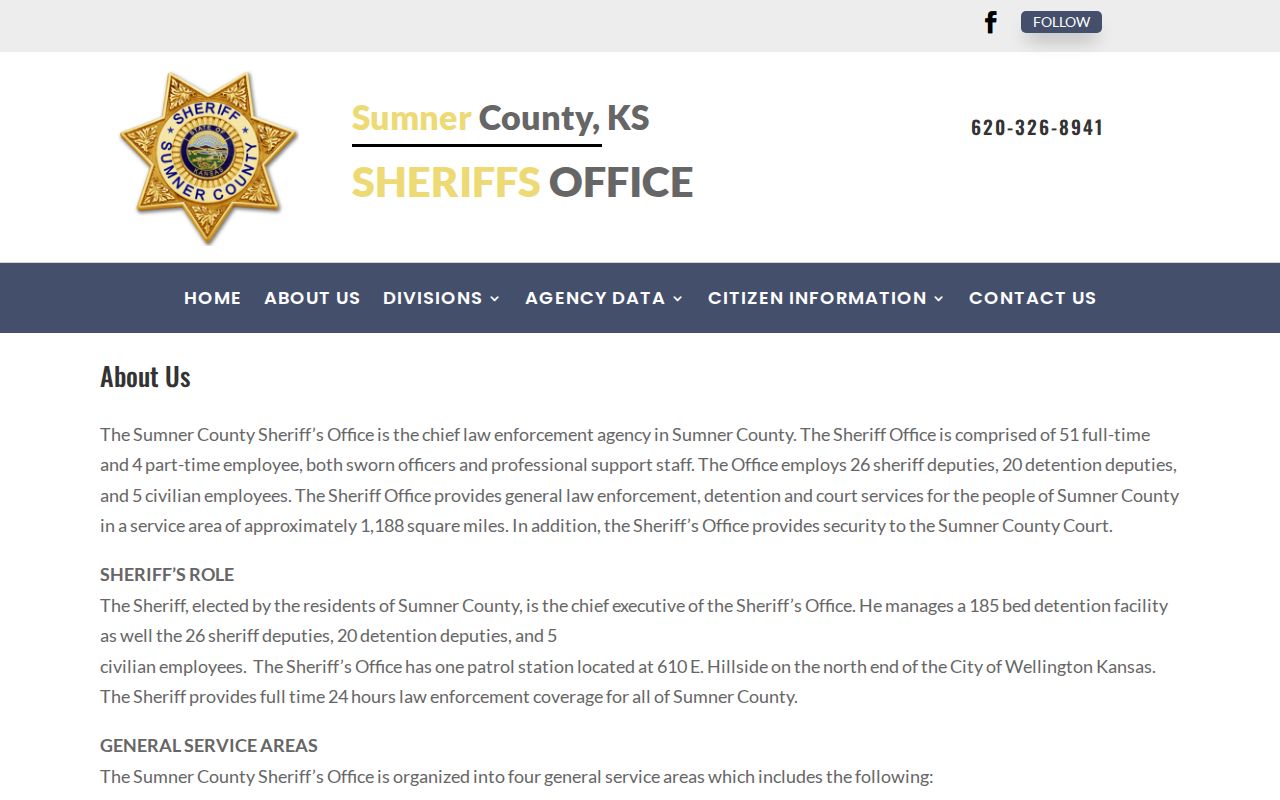
This source helps identify who operates the jail, but a release still must be verified through the system responsible for the person’s next status.
Sumner Facility Record Fields
A useful release record answers who left, when the departure occurred, who authorized it, and what status followed. Those questions call for more than a screenshot of an empty roster search. Ask for the smallest record that can answer the issue without reaching into medical, victim, investigative, or security material.
| Requested field | What it may clarify |
|---|---|
| Booking number | Matches the person to the correct jail event |
| Admission and release time | Marks the physical custody interval |
| Release category | Distinguishes bond, sentence end, or transfer |
| Releasing authority | Identifies the court or agency behind the event |
| Destination or receiving agency | Shows whether custody continued elsewhere |
| Hold or detainer | Explains why one order did not end all custody |
Kansas Open Records Act requests receive agency action as soon as possible and no later than the end of the third business day. That rule does not promise completed production in three days. The response may provide records, state a legal basis for denial, seek payment or clarification, or explain a delay and give the earliest availability.
Sumner Release Processing Limits
The Sheriff says booking can take two to three hours. Fingerprints and a mug shot must be completed before an inmate can be released. This fact explains why a court-authorized release may not appear at once, but it is not a daily release schedule. No official release hour, weekend procedure, exit point, gate-money practice, final property-return procedure, or universal county good-time formula was located.
Cash-only bond requires the full amount. The inmate receives a receipt or copy, and the money may be applied to court costs or fines at the court’s discretion. Jail staff cannot recommend a bondsman. Bond approval and payment are still distinct from the last physical steps at the jail, especially when another hold exists.
Property may be released once during custody at the inmate’s initiative to a person who presents photo identification. Property refused during intake may remain with the arresting agency. These published rules do not establish how all belongings are returned at final release, so call the jail about a specific property issue instead of assuming a standard handoff.
Sumner Work Release Is Custody
Sumner County’s work-release program allows an approved participant to leave for work under strict terms, then return to the jail. It is not a discharge or an open community release. Participation requires a court journal entry or order and final Sheriff approval. The application excludes violent-offense convictions, pending criminal cases, sentences shorter than 11 days, and a prior escape or unlawful departure.
Participants provide their own transportation and pay $20 for each workday from commissary. The form contains an inconsistent instruction stating “at least seven (5) business days.” Because the source conflicts with itself, the application should be read directly and the jail should confirm the current deadline. A roster appearance during work release remains consistent with custody even when the participant is physically at work for part of the day.
USMS Housing Is Not Release
The Sumner County Sheriff calls the facility contracted housing, and the roster includes “US Marshals Housing.” This is the distinctive local reason to treat disappearance with care. The U.S. Marshals Service manages federal prisoners from arrest until acquittal or commitment and uses local contract jails. A person can leave the Sumner County Detention Facility while remaining fully in federal custody at another location.
USMS does not offer a public historical locator like the Bureau of Prisons. Before commitment, use the federal court docket or clerk to understand the case and custody stage. After commitment to BOP, the BOP locator may show a location or later release date. “Released” or “Not in BOP Custody” means the person is no longer held by BOP, not that every supervision or other custody issue has ended.
No local ICE detention contract was verified. Use the ICE Online Detainee Locator only when an immigration handoff is documented or otherwise plausible in the specific case. An empty ICE result can reflect transfer, spelling or identifier mismatch, age restrictions, or a release outside the system’s limited display period. Never turn a county-roster disappearance into an unsupported claim of immigration custody.