
Sumner County Three-Day Release Gap
The Sumner County Sheriff does not publish a rolling 72-hour release page. Its jail roster reports people in current custody. It has no three-day filter, released archive, release field, or past-custody tab. No official web page can therefore be read backward to produce a list of everyone who left during a chosen three-day period.
A 72-hour inquiry differs from a same-day check. It often begins after time has passed, perhaps following a weekend or a missed alert. Build the period from a start time and end time, then reconcile a named person’s custody alert, court docket, and agency record. This method produces a defensible timeline. It does not pretend to be a countywide feed.
Check Sumner County 72-Hour Releases
Define the three-day window first. Use actual timestamps rather than “over the weekend,” since that phrase can hide which day a record belongs to. Then identify the custody system. The local route applies only to a person held at the Sumner County Detention Facility.
- Check whether the person is now shown on the Sheriff roster. Treat the result as a current snapshot, not historical proof.
- Review any Kansas VINE alert saved during the period. Separate release, transfer, and escape events.
- Match the booking to the correct court case through the arresting agency, charge, or case details.
- Look for a bond order, dismissal, judgment, time-served finding, probation order, or transfer-related event during the window.
- Request narrow release facts, including time, type, authority, destination, and any hold.
- Use KASPER or a federal channel only if the person entered that separate system.
Save the date and time of each check. Websites may change after the window closes. For an event likely confined to one day, the Sumner County 24-Hour Releases page gives the tighter method.
Sumner County Three-Day Fields
No official 72-hour list shows release fields, so the table below describes what to seek, not what the current roster publishes. Keep the booking identity tied to every event. A court order without a matching booking may belong to another custody episode, and a name alone may match the wrong person.
| Field to seek | Role in a 72-hour timeline |
|---|---|
| Name and booking number | Links the timeline to one county booking |
| Admission timestamp | Shows whether custody began inside the period |
| Release timestamp | Places the recorded local-custody end inside or outside the window |
| Release category | Distinguishes bond, court order, sentence completion, transfer, or another event |
| Authorizing court or agency | Points to the source that approved the action |
| Receiving agency or destination | Separates community release from continued custody |
| Detainer or hold | Explains why one case ending did not free the person |
The live Sumner roster offers different data: name, booking number, charges, bond, arresting agency, booking date and time, age, sex, and race. It omits every release field above. Never relabel current-custody facts as a three-day release dataset.
Sumner County Weekend Release Checks
A three-day window is useful because the first check may happen after more than one calendar day. Still, Sumner County publishes no weekend release policy, holiday rule, standard exit time, or usual processing delay. Do not claim that releases are postponed, advanced, or grouped on a certain day. Ask what the records show for the particular booking.
Court timing and physical release can differ. A judge may authorize bond or enter a dismissal, but staff may still need payment confirmation, paperwork, identity checks, and review for other holds. A court docket preserves the legal event. It may not record when the jail door opened. VINE may preserve a custody-change alert, while an objective Sheriff record may supply the release time if disclosed.
When Monday is the first chance to check, set the window back by a full 72 hours and note the exact endpoints. Search the right court. Sumner District Court handles state criminal matters in the 30th Judicial District. Wellington Municipal Court handles city-ordinance cases. A durable court record can remain after the live roster entry is gone.
Sumner County Three-Day Fallbacks
Kansas VINE is the most immediate documented fallback for one named county-jail detainee. Sumner County says it transmits jail updates every 15 minutes. Supported alerts include release, transfer, and escape. A phone alert uses a four-digit PIN; entering the PIN followed by the pound key acknowledges the call and stops repeats. Email sends a custody-change message without a PIN. Kansas material also describes text and in-app options.
VINE is not a history of all people released during three days. Registration may be unavailable after the person has left. Nor does Kansas VINE cover KDOC prison offenders. For a person sentenced to Kansas corrections, search KASPER by identity and review status and movement information. Inmate, Parole, and Discharged mean different things. KASPER updates on working days and is not a rolling county release feed.
A Kansas Open Records Act request can seek objective local release fields. Give the Sheriff a narrow date range, identity, and booking number when known. K.S.A. 45-218 governs inspection and agency response, while K.S.A. 45-219 addresses fees. Yet no dedicated Sumner release form, fixed fee, or specific turnaround was found. The Sheriff also states that after release no information may be released, so a response cannot be promised.
Why Sumner County Releases Vanish
Sumner County’s current-only design creates a sharp boundary. The roster has no released date, archive, rolling window, or public retention rule. The Sheriff’s Detentions page also says no information may be released after an inmate is released. That combination is the county’s distinctive data issue: the point when a person becomes relevant to a recent-release search is also the point when the public roster no longer helps.
Absence has many explanations. A person may have bonded out, finished a local term, received probation, transferred to another county, entered KDOC, moved in federal custody, escaped, or experienced another custody event. Only some mean return to the community. The Detentions source below records the local cutoff and VINE channel.
Read the official Sumner County Detentions source before relying on the process described here.
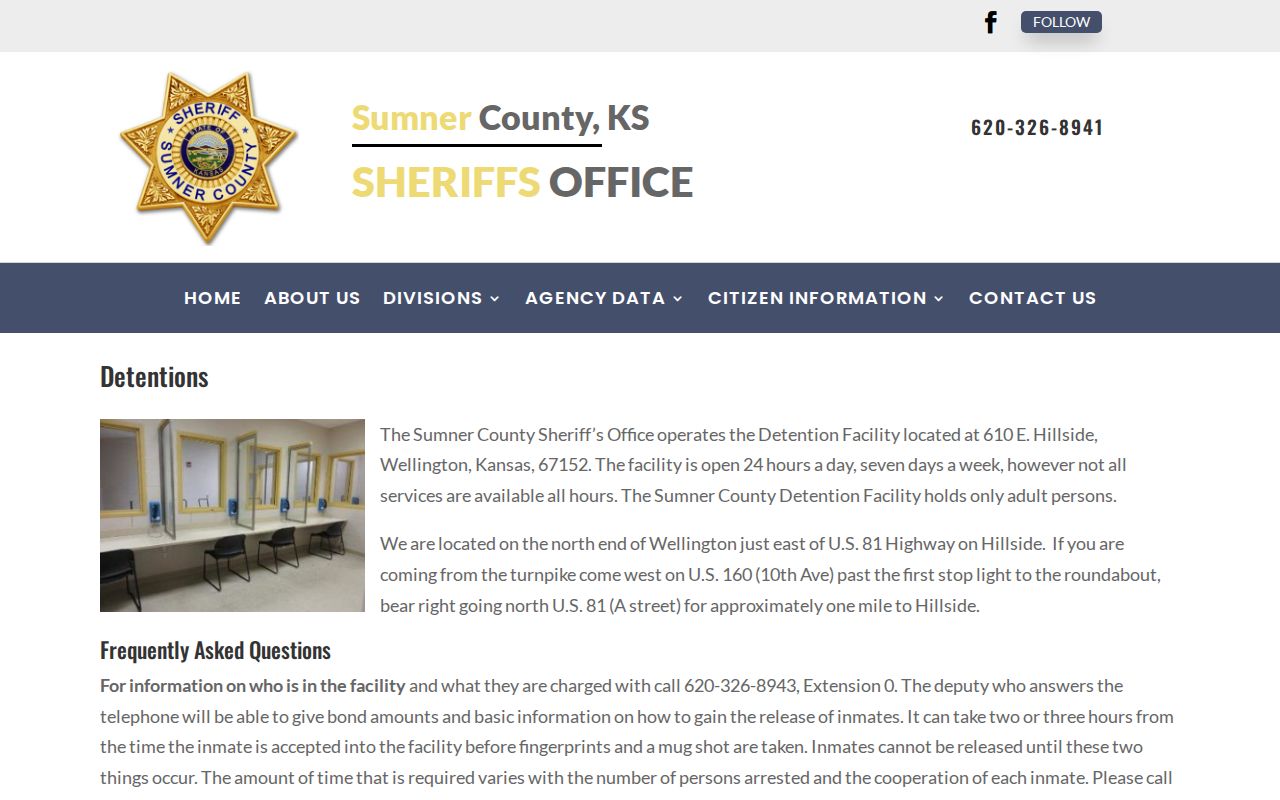
The screenshot supports use of VINE and a narrow records strategy. It does not create a missing 72-hour feed.
Sumner County Release System Boundaries
The Sumner County Detention Facility houses local arrestees and contracted prisoners. Its roster has shown the Sheriff, Wellington Police Department, Belle Plaine Police Department, Kansas Highway Patrol, and U.S. Marshals Service as arresting agencies. Physical location at one jail does not mean every person has the same legal custodian or next destination.
For county-only custody, use the roster as a present-status check, VINE for a registered event, the court for legal authority, and the Sheriff for requested fields. For KDOC custody, use KASPER. For a federal detainee marked as U.S. Marshals housing, review the federal docket and USMS custody path. After commitment to BOP, the BOP locator may show a release date and location. Transfer between contract jails is not release.
No local ICE detention contract was verified. If a record documents an immigration handoff or detainer, use the ICE Online Detainee Locator System. A no-result has several possible causes and cannot prove community release. The Sumner County named-person search guide maps these systems when a three-day timeline crosses agency lines.
Read Sumner County Roster Carefully
The current Sheriff roster can anchor the end of a three-day inquiry. If the person appears, the page is reporting current local custody at that moment. If the person does not appear, record only that negative observation. Do not assign a date or reason to the absence.
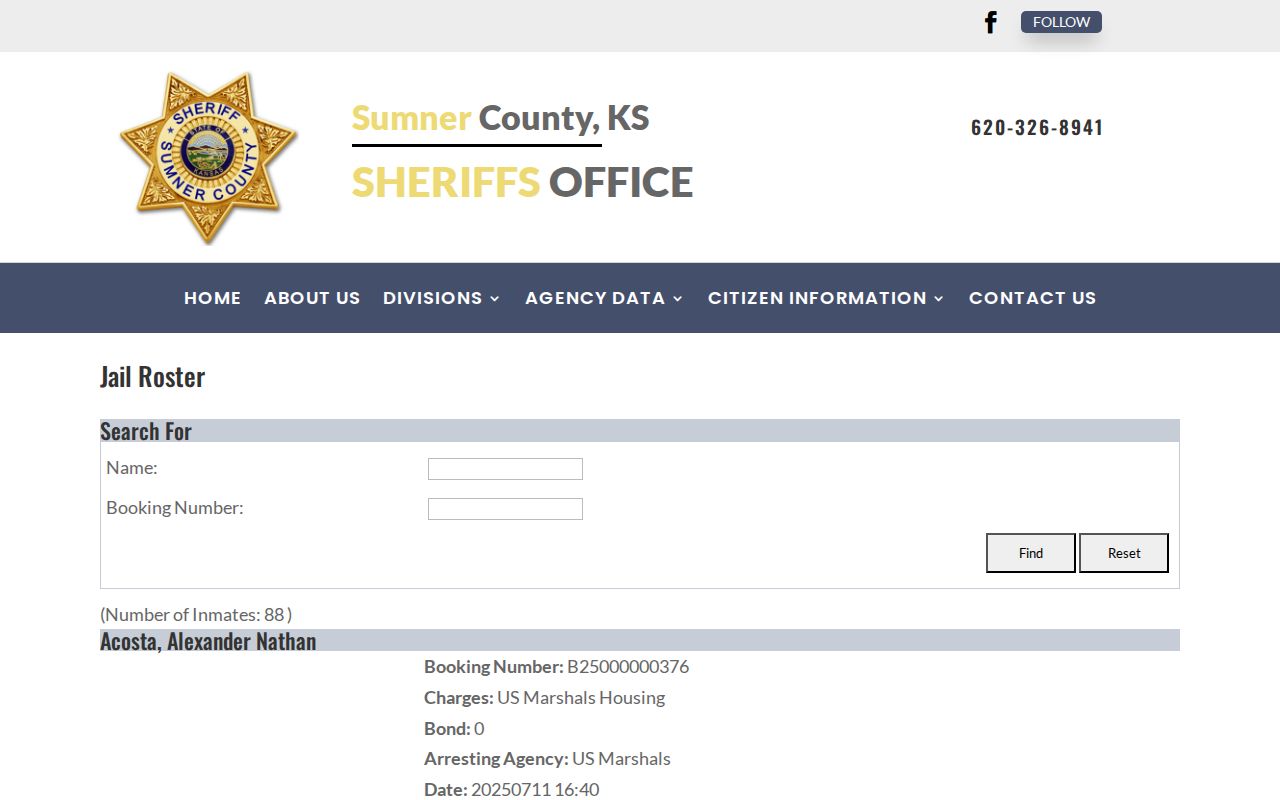
The capture shows why a separate timeline is needed. It contains present booking data but no released people, release timestamp, release reason, destination, photo, or three-day archive.
Keep copies only as dated observations. A later roster view may differ because the jail population changed, not because the earlier capture was wrong. When two checks bracket the event, they establish only that the public display changed between those times. The court, VINE event, or agency record is still needed to narrow the actual custody change.